Ms. Dithny Johan Raton, Special Labor Ombudsman for the Garment Sector in Haiti, President of the PAC.
Secretariat
Ms. Claudine François, Country Technical Advisor, Representative of the International Labor Organization.
It is through this collaboration that we are able to understand the specific needs of our constituents and develop and implement a programme that will have the greatest impact and potential for making sustainable change.
Our key social partners are represented through the members of our tripartite Project Advisory Committee (representatives from relevant ministries, employers, and workers’ unions). The PAC helps to guide the programme on both policy issues as well as operational implementation decisions. This committee is comprised of representatives from the government of Haiti, of employers’ associations and of the trade unions.
Ms. Dithny Johan Raton, Special Labor Ombudsman for the Garment Sector in Haiti, President of the PAC.
Ms. Claudine François, Country Technical Advisor, Representative of the International Labor Organization.
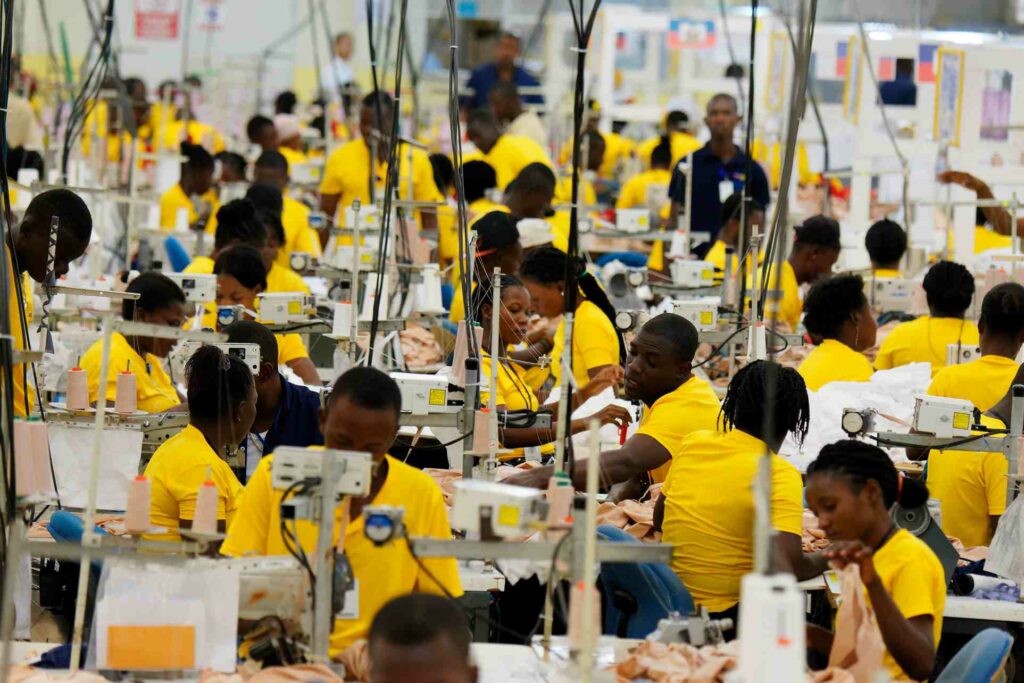

We work with unions and directly with workers to help realize their rights on the factory floor and find ways to boost their skills so that they can engage in productive discussions and negotiate with employers. Thus, approximately 85% of those exporting apparel factories in the country now have a union presence. The unions are part of Better Work’s engagement in various ways. They participate in sectorial training or special training that are specifically designed for them. Union representatives are also represented in the bipartite committees at the factory level.

Factory enterprises are key partners in our efforts to create better conditions for garment workers in a way that also boosts business performance. We believe that effective cooperation and mutual trust between employers and their workers not only leads to better working conditions but also better results for business.
All Haitian apparel factories exporting to the United States under the HOPE II legislation have to participate in a technical assistance program which is being implemented by Better Work Haiti. For full participation in the programme, factories have to pay an annual subscription fee which grants additional services, such as access to the online portal through which reports can be shared with subscribed buyers or special events such as the annual Better Work forum in Haiti.
Better Work aims for individual factory improvements to have a ripple effect across national industries and impact vast numbers of lives. To that end, a crucial relationship for us is the one we have with national government bodies who have the power to enact good laws that offer protection and rights in countries where we work.

We influence national-level labour issues by harnessing the ILO’s long-held expertise as a convener, bringing together the various actors in the labour field and promoting social dialogue. To do this, we build tripartite platforms of government (usually ministries of labour) employers and trade unions in each of our country’s programmes. These Project Advisory Committees meet regularly and provide guidance for our work and effective solutions for industry progress benefiting workers, businesses and the country.
In Haiti, an ILO capacity building partnership with the Ministry of Social Affairs and Labor (MAST) is being implemented in close coordination with Better Work Haiti. In order to enhance this collaboration, two important documents have been signed between Better Work Haiti/ILO and MAST in November of 2015.
A general Memorandum of Understanding (MoU) on the collaboration between the two institutions aims at harmonizing and coordinating their respective interventions in the Haitian garment industry in order to improve working conditions in the sector. As part of the partnering capacity building project for MAST, ILO-MAST labour inspectors now conduct joint visits with BWH Enterprise Advisors (EAs). During these “shadow visits”, EAs explain the BW assessment and advisory process to the inspectors. Meetings are held apart from these factory visits to discuss the direct factory level intervention.
To learn more about these two agreements, please consult the documents below.

Our brands, retailers and intermediaries are industry leaders in the movement to reimagine the global supply chain, where workers’ rights are realised and businesses gain a competitive advantage to grow.
Brands and retailers whom are BWH partners commit to coordinate efforts in order to maximize impact, for example by reducing duplicate audits and by supporting improvement efforts of suppliers in a manner that is complementary and reinforces BWH’s assistance to factories. In addition to having access to BWH assessment reports, our partners have regular interactions with BWH and the global Better Work programme to discuss industry developments and factory-level issues.
Our work is funded through a combination of private sector fees for our services and grants from donors. We work closely with development partners to understand specific interests and goals and help to advance these goals through Better Work’s efforts. Development partners are actively engaged in our programme and are key partners in the development of strategies to improve the garment sector supply chains.